Showing posts with label space. Show all posts

22 July, 2009

The power of wonder

Oh where, oh where has this gone?

There's an interesting piece today in the LA Times ("The final American frontier" by Ted Anthony of the AP), exploring our waning wonder for space exploration. It's not really remarkable anymore when the space shuttle launches and images of astronauts space walking and doing other astronauty things are no longer broadcast live (or even at all). But it ought to and they should be. I mean, how many people do you personally know who have orbited our planet (one of the estimated trillions in the universe)?

We are 40 years older now, we Americans. And many things have changed.

The final Apollo mission came home before Nixon resigned. Skylab fell to Earth. Challenger disintegrated going up, Columbia coming down. Kennedy's New Frontier ethos — space as a kinder, gentler Manifest Destiny — slouched into the "Alien" catchphrase: "In space, no one can hear you scream."

Today, the reasons for Americans to pay attention to the ground, rather than the heavens, can be rattled off like a parody of a Billy Joel song. Terrorists. Global warming. Swine flu. Economic collapse. Nukes in North Korea and mass shootings in the heartland.
We didn't (couldn't?) keep the fire going. And then the $64,000 question: "Is space, the final frontier, still the American place to aim for?" Well, you can guess my answer. The article cites a 2006 Gallup survey, in which nearly half of Americans said the money spent on the space shuttle program would have been better spent on something else, and 13% basically said "hell no" to funding any space exploration.

$how us the money. But first a slight segue...

I didn't fully get the story of Pandora and her box the first time I read it in middle school. I thought Hope should have been set free along with all the plagues, since escaping is what activated them - how could we hope if it was still trapped in the box? But then I realized we don't hope, we have it. You can't own something unless you have a place to keep it. Which brings us to the National Air and Space Museum:

Walk past an actual Apollo landing module and think: How in heaven did we land on the moon in something like this? It looks like a foil-and-tarpaper float built for a homecoming parade.

And then, if you can get to the front of the circle of people ringing it, stand in front of the actual Apollo 11 command module, Columbia.

Then pause, and listen to the voices around you.

"... actual re-entry capsule ..."

"... Collins stayed in the command module ..."

"... looks like a beehive on the bottom ..."

"... can't believe someone did that ..."

In German and Chinese, Japanese and Hindi and, yes, American English, they marvel still at this conical piece of mottled metal that traveled so far. They pose for pictures, shoot video.
The fire isn't dead, the embers just need stirring up.

You see, it's what I like to call trickle down science. It's not just science that benefits from funding science. Thanks to space exploration we have satellite technology (tv and radio), global communications, pacemakers, better golf balls, solar photovoltaic energy, Tang (and by extension, KoolAid, Crystal Light, etc) and Velcro®. Of course, we didn't exactly know all that at the time exploration and the Apollo missions were being funded, but we've all benefited in these and countless other ways.

Some middle of the week space shenanigans

Wednesday is "hump" day, and I'm finding it particularly difficult this week. So in case you're likewise in need of a little R&R, here's a space stroll down memory lane...

A. Space Ghost, Jace, Jan and Blip rocked! I think I may have had a child crush on Space Ghost.

B. Do you remember the three-part series when the cast of Star Wars joined the Pigs in Space crew (double space points!)?

C. The best arcade game IMHO.

21 July, 2009

Space baubles

Because you know I can't let another week go by without some chunkiness...

I am liking Stephanie Carbone's designs "inspired by sky and sea" over at SpaceMermaid. Not sure I've been completely converted from my disdain of brass-plated jewelry, but at these prices I can afford to give it a try. I mean, have you seen the sea horses - how cute are those?!

A. This design is sold out. Damn!

B. Bubble Pearl necklace, 18/24/30 inches, $65 at SpaceMermaid.

More space-inspired items with which to adorn yourselves or the loved ones in your life:

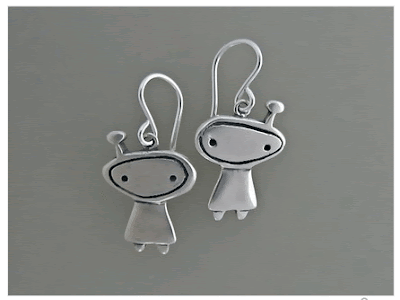
C. These might be the cutest aliens ever depicted. Orbit Girl sterling silver charm earrings, $32 by marmar on Etsy.

D. A little love for the guys. The T3 (you can choose a polished or matte finish), $779 at Jeweler's Touch. The tension setting is ultra cool, and I think titanium is a pretty bad ass element.

You want the real deal? NASA has meteorite jewelry in its online store.

20 July, 2009

A plug for The Intersection of science and policy (via communication)

Lots to show and tell about space this week, this is only the beginning.

A blog I read pretty regularly is Chris Mooney's and Sheril Kirshenbaum's The Intersection. I had to re-post this video - it is a freakin' AWESOME marriage of pop culture/entertainment and science!
"The LHC is super duper fly."

For the rest of Mooney's post, which details a radio interview you may have heard on NPR's Living Earth, click here. May I also suggest you check out their new book (I haven't read it yet, but it's on my list!), Unscientific America:

"Viva Pluto!"

"Stop Planetary Discrimination!"

"Pluto Was Framed!"

"Dear Earth: You Suck. Love, Pluto."

"Pluto is still a planet. Bitches."

So read a small sampling of the defiant T-shirt and bumper sticker slogans that emerged in late 2006 after the International Astronomical Union (IAU), meeting in Prague, opted to poke the public with a sharp stick. The union's general assembly voted to excommunicate the ninth planet from the solar system, thus abruptly stripping Pluto of a status as much cultural, historic, and even mythological as scientific.

In the astronomers' defense, it had become increasingly difficult to justify calling Pluto a planet without doing the same for several other more recently discovered heavenly objects--one of which, the distant freezing rock now known as Eris (formerly "Xena"), turns out to be larger. But that didn't mean the experts had to fire Pluto from its previous place in the firmament. In defining the word "planet," they were arguably not so much engaged in science as a semantic exercise, meaning that instead of ruling Pluto out, they could just as easily have ruled a few new planets in, as a group of scientists, historians, and journalists had in fact proposed. But the IAU rejected that compromise for a variety of technical reasons: Pluto is much smaller than the other eight planets; it orbits the sun in a far more elliptical manner; its gravitational pull is not strong enough to have "cleared the neighborhood around its orbit" of other significant objects and debris…

People were aghast. Not only did they recoil at having to unlearn what they had learned as children, and perhaps the chief thing they remembered about astronomy. On some fundamental level their sense of fair play had been violated, and their love of the underdog provoked. Why suddenly kick Pluto out of the planet fraternity after letting it stay in for nearly a century, ever since its 1930 discovery? "No do-overs," wrote one cartoonist.

Soon websites started sprouting up encouraging people to vote on Pluto's status and override the experts. A Facebook group entitled "When I was your age, Pluto was a planet" drew a million and a half members. New Mexico, the state where Pluto's discoverer, Clyde Tombaugh, had built an astronomy program, took particular offense. Its House of Representatives voted unanimously to preserve Pluto's planethood and named March 13, 2007, "Pluto Planet Day." Surveying it all, the American Dialect Society selected "plutoed" as its 2006 word of the year--as in, "you plutoed me." The society offered this definition: "to demote or devalue someone or something, as happened to the former planet Pluto when the General Assembly of the International Astronomical Union decided Pluto no longer met its definition of a planet."

Even many scientists were upset. "I'm embarrassed for astronomy," remarked Alan Stern, the chief scientist on NASA's New Horizons mission to Pluto and beyond... (keep reading this excerpt)

Space week

A. Earthrise 1968 by William Anders/NASA (Video of the Earth rising and setting was captured in HD by the Japanese space agency and released last year. You can view it and other images, as well as geek out on how they caught the events on camera, here.)

I can't help but be curious, awestruck and inspired when I look up into a clear night sky. Unfortunately, I find I must go further and further now to see a starry sky.

The 40th anniversary of the first humans landing on the moon is as good as any moment to pause and reflect on how much we know, and how much we don't.
B. Dr. Sylvia Earle's TED Prize wish to protect our ocean (February 2009). This grandma kicks some serious science butt.

Here's to those who devoted their lives to exploring the great unknown, in space and right here on our own tiny planet. And here's to hoping that once again our nation's science coffers will be expanded as they were under Presidents Eisenhower and Kennedy.


UPDATED 7/26/2009 - Here is a roundup of Space Week posts following this one: